


By Howard L. Simon, Clean Okeechobee Waters Foundation
Another legislative session brings another opportunity for Florida policymakers to protect our water and our health.
So far, state Sen. Carlos Guillermo Smith has stepped up to the plate. His proposed Senate Bill 1386 tasks the Department of Environmental Protection with setting standards and rules for onsite sewage treatment and disposal systems, aka septic systems. It also requires septic systems (and presumably the adjacent surface and groundwater) to be inspected every five years.
Presumably, if warranted, repairs will be required. A grant program should help alleviate the burden on low-income homeowners.
This is a long-simmering problem – and with shrinking agricultural land and unceasing development, it is getting worse.
In 2019, after the twin disasters of extensive red tide along the Gulf Coast and massive outbreaks of blue-green algae in the Caloosahatchee River, the St. Lucie River and the Indian River Lagoon, newly elected Gov. Ron DeSantis appointed a Blue-Green Algae Task Force consisting of some of the state’s leading environmental scientists.
One of the task force’s recommendations noted that there are “more than 2.5 million septic systems in Florida that treat approximately one-third of the wastewater generated in the state. The nutrients in the effluent from these systems contribute to the development and maintenance of harmful blue-green algae blooms.”
The task force recommended “the development and implementation of a septic system inspection and monitoring program with the goal of identifying improperly functioning and/or failing systems so that corrective action can be taken to reduce nutrient pollution, negative environmental impacts and preserve human health. At present there is no requirement that conventional septic systems be inspected post-installation.”
The Florida Realtors association also pointed to the urgent need to address this problem. In 2024, the association reported that with “2.7 million septic tanks buried in Florida and an estimated half of those more than 30 years old and 9.5% continuously failing, Florida is facing mounting environmental and water-quality challenges.”
But what the Sunshine State faces is not only a threat to the quality of our water supply – alarming as that is. We also face a significant threat to our health.
The Centers for Disease Control and Prevention (CDC) warns that toxins (aka poisons) produced by blue-green algae (or cyanobacteria) make people and animals sick.
What is insufficiently appreciated is that one particular toxin, BMAA (Beta-N-methylamino-L-alanine), has been linked to neuro-degenerative diseases like ALS and Alzheimer’s.
Dolphins, specifically the brains of beached dolphins, may be the “canary in the coal mine” warning of the elevated risk of neuro-degenerative diseases from chronic exposure to blue-green algae.
In September, researchers at Brain Chemistry Labs; the University of Miami’s Miller School of Medicine and its Rosenstiel School; Hubbs-SeaWorld Research Institute and the Blue World Research Institute published findings that the brains of beached dolphins found in Florida’s Indian River Lagoon contained the cyanobacterial toxin BMAA and had the neurological hallmarks of Alzheimer’s disease.
That toxins produced by cyanobacteria can trigger neuro-degenerative diseases like Alzheimer’s in dolphins is a warning for people residing or recreating in and around waterways polluted with blue-green algae.
This threat may be underappreciated in part due to the difference between how we experience exposure to red tide and blue-green algae. Those who came close to an outbreak of red tide typically experienced – almost immediately – headaches, itchy eyes and respiratory illnesses.

On the other hand, liver and other cancers and diseases of the brain linked to chronic exposure to cyanobacteria have a longer latency period. The elevated risk of these serious illnesses with longer latency means that we are being slowly poisoned.
The Legislature addressed this health risk 16 years ago, adopting legislation sponsored by former state senator and now Seminole County Commissioner Lee Constantine. Sadly, it was repealed before the inspection program went into effect.
Septic-to-sewer conversion is the policy of the DeSantis administration. Good – but until enough sewage treatment plants are built and every home is hooked up, there will be hundreds of thousands of old and malfunctioning septic systems along our rivers, streams and waterways leaching nutrients that feed blue-green algae.
If there ever was legislation that is non-ideological and urgently needed, bringing together environmentalists, scientists, realtors and medical researchers – requiring regular inspections of septic systems is it!
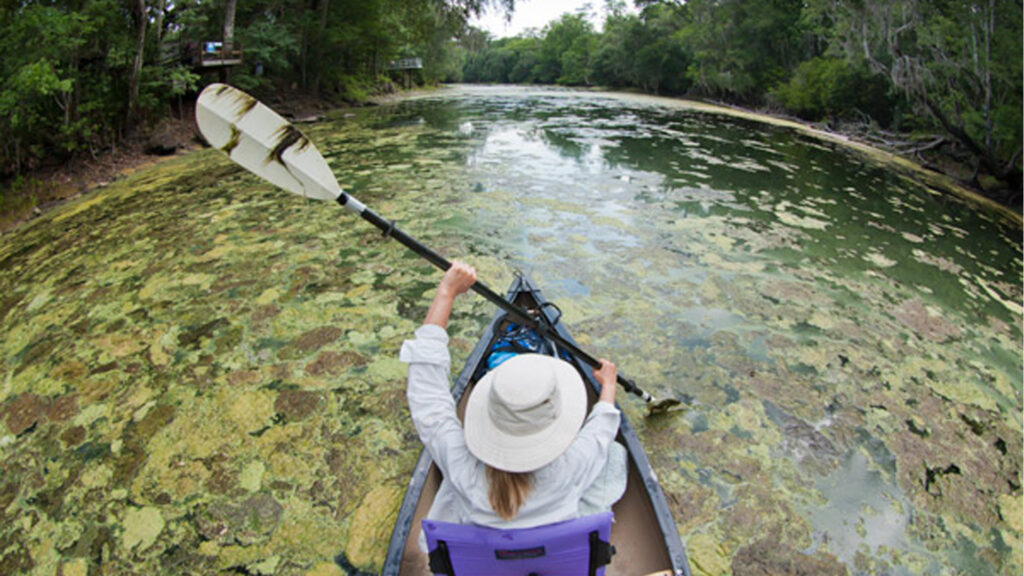
Howard L. Simon, Ph.D., is president of Clean Okeechobee Waters Foundation. He served as executive director of the American Civil Liberties Union (ACLU) of Florida from 1997–2018. Banner photo: A canoeist’s paddle scoops up algae on the Santa Fe River. (John Moran, Public domain, via Wikimedia Commons).
Sign up for The Invading Sea newsletter by visiting here. To support The Invading Sea, click here to make a donation. If you are interested in submitting an opinion piece to The Invading Sea, email Editor Nathan Crabbe. To learn more about harmful algal blooms, watch the short video below.
