


By Sol Moyano, The Invading Sea
As climate change has fueled rising temperatures and extreme weather, natural disasters causing $1 billion or more in damage have happened with increasing frequency in the U.S. in recent years.
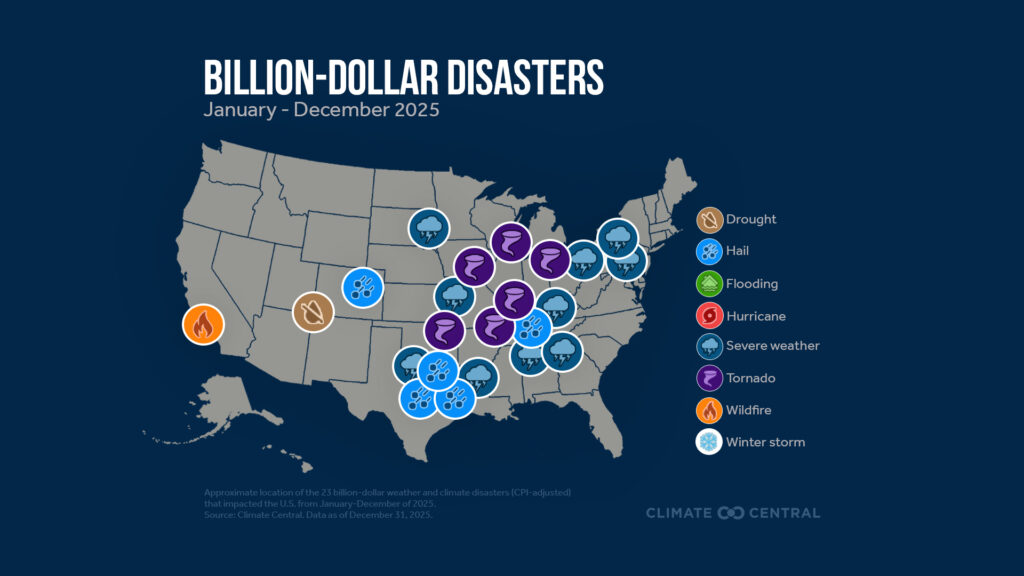
A new study by Climate Central reports that there were 23 climate- and weather-related disasters causing at least $1 billion in damage last year in the U.S., placing 2025 as the third-highest year for billion-dollar disasters since records on these disasters started being collected in 1980. 2023 and 2024 took the first two spots in the rankings. All figures are adjusted for inflation.
“The rising cost of billion-dollar disasters is driven by a combination of greater exposure and vulnerability — more people, homes and infrastructure located in harm’s way — and extreme weather becoming more intense due to human-caused climate change,” said Adam Smith, senior climate impacts scientist at Climate Central.
The National Oceanic and Atmospheric Administration (NOAA) used to keep track of billion-dollar disasters in the U.S. But the Trump administration announced in May that it would no longer update the database.
Climate Central, a nonprofit group of communicators and scientists who research climate-related issues, created its own database in October to spread awareness of such occurrences.
“Climate Central took over the billion-dollar disaster database because the analysis is vital for communities, decision-makers, researchers and the public to truly prepare for and reduce the risk from extreme weather and climate disasters,” Smith said.
The January 2025 wildfires in Los Angeles, California, were the costliest disaster of the year. According to Climate Central, the wildfires have caused $61.2 billion in damage, becoming the costliest wildfire in U.S. history.
Droughts, tornadoes and hailstorms also carried hefty price tags that exceeded $1 billion.
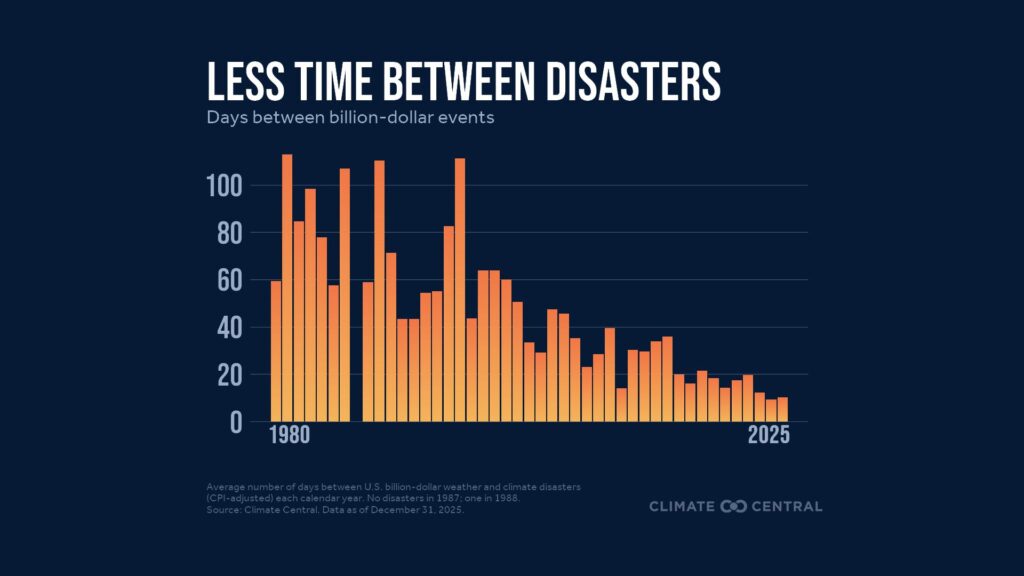
While there have been multiple billion-dollar disasters since the 1980s, the frequency of such disasters has increased. The average time between disasters in the 1980s was 82 days. In 2025, the average was just 10 days.
The increase in billion-dollar disasters comes as climate change is increasing global temperatures and extreme weather events. The World Meteorological Organization reports that “the past 11 years (2015-2025) are set to be the warmest on record, with each year surpassing previous temperature highs,” while the world also experiences extreme events ranging from “devastating rainfall and flooding to brutal heat and wildfires.”
“Attribution studies examine the role of climate change in individual events, and the broader scientific consensus is clear that human-caused climate change is amplifying the risks that lead to costly disasters,” Smith said.
He said that greenhouse gas emissions contribute to these costly disasters.
“Reducing future disaster losses requires addressing the root cause — reducing fossil fuel emissions,” he said. “This is critical to limiting even more intense and frequent extreme weather in the future.”
He said the U.S. is likely to see a similar number, if not more, of these disasters in the years ahead.
“Climate change is increasing the likelihood of certain extremes, and ongoing development in risk-prone areas means damages are likely to remain elevated or increase further,” he said.
Sol Moyano is a senior majoring in multimedia journalism at Florida Atlantic University who is reporting for The Invading Sea in the spring 2026 semester. Banner photo: A firefighter at the Palisades Fire in Southern California on Jan. 8, 2025 (CAL FIRE, Public domain, via Wikimedia Commons).
Sign up for The Invading Sea newsletter by visiting here. To support The Invading Sea, click here to make a donation. If you are interested in submitting an opinion piece to The Invading Sea, email Editor Nathan Crabbe.
