


By Gisele Galoustian, FAU News Desk
Living organisms must constantly adjust to their environment to survive. One of the most fundamental challenges is temperature. Even small shifts in heat or cold can disrupt the delicate balance inside cells, affecting how genes function and how tissues respond.
As climate variability intensifies and extreme heat events become more common, understanding how organisms cope with temperature stress is increasingly important – not only for biology, but for human health, agriculture and ecosystem resilience.
At the core of this challenge is homeostasis – the ability of living systems to remain stable even as their environment changes. In this case, cells do so by adjusting gene activity in response to shifting temperatures.
This raises a critical scientific question: How do diverse species maintain cellular stability under such different environmental conditions?
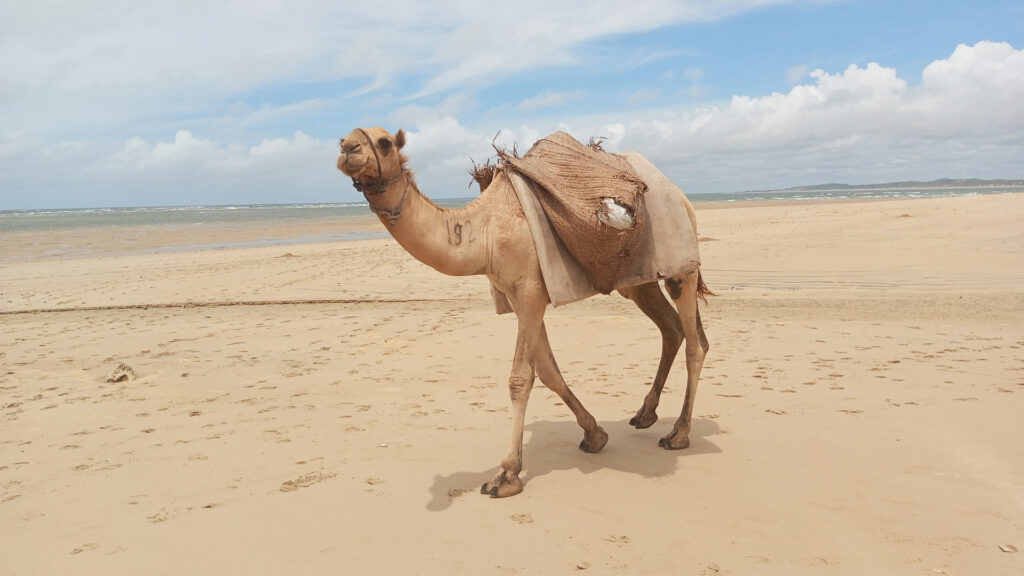
To answer this question, Florida Atlantic University researchers and collaborators explored how mammalian cells respond to temperature changes at the genetic level. They studied one-humped camels commonly found in hot, arid regions like North Africa and the Middle East, and humans. They focused on skin fibroblasts – cells that help maintain tissue structure – and tracked how gene activity shifts at different temperatures. Camels offered a compelling comparison because their ability to thrive in extreme heat provides insight into biological resilience.
However, a major challenge in this type of research is identifying differentially expressed genes –genes that change their activity in response to environmental stress. Traditional methods for detecting these changes rely heavily on large datasets and statistical testing, which are often not feasible when only a small number of biological samples are available.
To address this limitation, the researchers developed a model that compares how genes behave across individuals before and after an environmental change. Rather than simply tracking whether genes go up or down, it focuses on how consistent the response of each gene is across individuals. Genes that remain steady – or become more consistent across individuals – are identified as key players in helping the body maintain stability under stress, allowing scientists to study these responses even with smaller datasets.
The researchers then grouped genes into a few categories that describe how cells respond to heat and built models of how these genes interact under both normal and stressed conditions, revealing how cells maintain balance even when disrupted.
Results, published in the journal BMC Genomics, found that mammals respond to temperature changes using three main groups of genes that act like a simple system for organizing how cells react to heat. Some genes stay stable and help control the response, others switch on specifically when temperatures change, and a third group becomes more erratic, reflecting stress in the system. This approach allowed the scientists to simplify complex gene activity and better understand how different species cope with environmental changes.
When comparing humans and camels, the researchers found clear differences. Notably, their measure of cellular well-being showed that camels ranked higher than humans under both moderate (98.6 F) and extreme (105.8 F) temperatures, highlighting their greater tolerance of heat stress.
Human cells tend to respond in a more rigid and tightly controlled way, which can make them less adaptable under heat stress. In contrast, camel cells show a more flexible and coordinated response, allowing them to stay stable even at higher temperatures. Overall, the findings suggest that camels are biologically better equipped to handle heat, while humans are more vulnerable to temperature extremes at the cellular level.
By reducing complex genetic activity into a small set of meaningful patterns, this work offers a new way to understand how cells maintain balance – and why some species are better adapted to survive environmental change.
“This research gives us a fundamentally new way to think about resilience in biological systems,” said Valery Forbes, Ph.D., co-author, professor of biological sciences and dean of FAU’s Charles E. Schmidt College of Science. “By focusing on how gene expression variability changes under stress, we can identify mechanisms that help some species maintain stability while others become more vulnerable. This approach also works with limited data, making it useful for studying how organisms respond to climate shifts and other environmental pressures even when sample sizes are small.”
Beyond temperature adaptation, the framework provides a broader way to understand complex systems. By identifying core patterns of response and interaction, it can be applied to other biological and ecological systems, including how ecosystems, microbial communities and other interconnected networks adapt to changing conditions.
Study co-authors include first author Jorge Gonzalez, Ph.D., a former post-doctoral researcher in the Schmidt College of Science at FAU who worked with Forbes, now at Embry-Riddle Aeronautical University; and researchers from FAU, Broad Institute, the University of Minnesota, the University of Florida, the University of Nevada, Las Vegas, and the San Diego Wildlife Alliance.
This work was funded by a National Science Foundation Understanding the Rules of Life Collaborative Research Grant awarded to Forbes; and co-authors Diane Genereux, Ph.D., Broad Institute; Allyson Hindle, Ph.D., University of Nevada, Las Vegas; and Elinor Karlsson, Ph.D. Broad Institute.
This piece was originally published at https://www.fau.edu/newsdesk/articles/camels-beat-the-heat-study.php. Banner photo: A camel in Morocco (Bjørn Christian Tørrissen, CC BY-SA 3.0, via Wikimedia Commons).
Sign up for The Invading Sea newsletter by visiting here. To support The Invading Sea, click here to make a donation. If you are interested in submitting an opinion piece to The Invading Sea, email Editor Nathan Crabbe.
