


By Katy Saeger, Harmonica
Returning to Florida after a week of United Nations debates and conversations in New York — climate, economy, energy — everyone has an opinion, but with rhetoric divided. Yet, somewhere between the headlines and the hashtags, one truth keeps resurfacing for me: Nature is not our opponent. Nature is our partner.
As someone who spent years working with leaders and companies through crises — reputational, environmental and social — I’ve seen firsthand that the most resilient systems, like the most resilient people, are the ones that work with their environment, not against it. Here in Florida, that truth is visible in every tide and every storm.
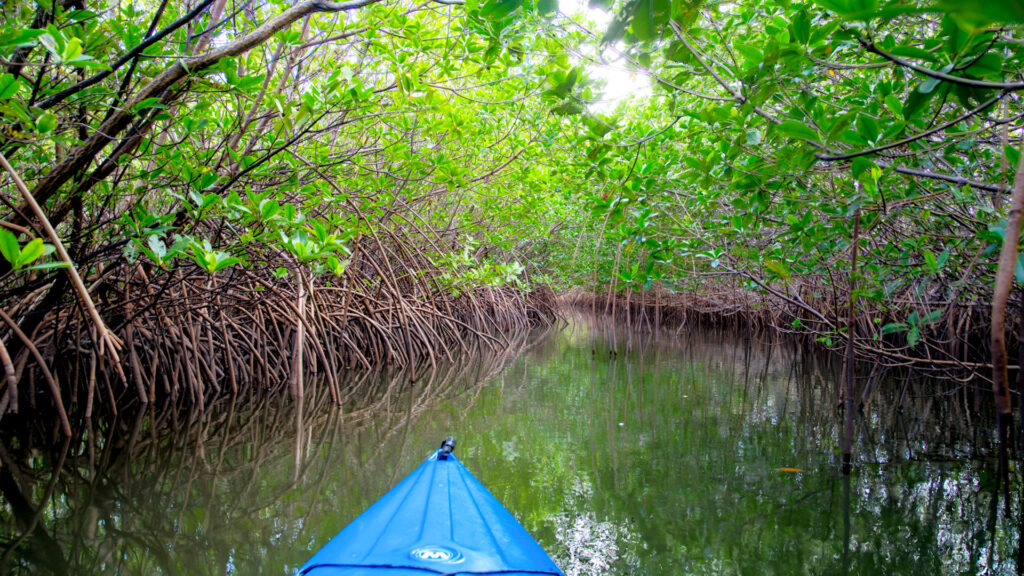
Flying over the state, you see an intricate tapestry of bays, estuaries and mangrove forests — the natural infrastructure that buffers our coasts and feeds our economy. But between the ribbons of green and blue, there are scars: seawalls where wetlands used to be, subdivisions where floodplains once absorbed rain. We live in a subtropical paradise that is both resilient and fragile, and too often we try to outbuild the very systems that protect us.
This isn’t a call to stop building. In fact, I am deeply inspired by the growth in this region and the magnificent landscape. This is a call to build wisely.
Florida’s future — and America’s — lies not in halting development but in aligning progress with preservation. When we conserve wetlands and mangroves, we’re not just saving birds or fish; we’re protecting real estate, insurance markets and local economies. Every dollar invested in natural infrastructure pays dividends — saving millions in storm recovery, property loss and insurance premiums.
The economics make the case. Florida’s mangroves provide $2.7 billion in storm and flood protection every year. In Collier County alone, they prevent an estimated $67 million in damages annually. The Tampa Bay Estuary supports over 200,000 jobs and generates more than $32 billion in annual output — while increasing property values for homes near healthy waters by $3.2 billion. Those are not activist numbers; they’re business fundamentals.
And it doesn’t stop at the water’s edge. On land, regenerative farms across the Southeast are delivering 15–25% higher returns over a decade and up to 120% greater profits than conventional models — while improving soil, sequestering carbon and protecting groundwater. Florida’s aquaculture industry now contributes $165 million a year, with integrated systems that turn shellfish and seaweed into both food and natural filtration.
In other words, conservation isn’t just good ethics. It’s good economics.
For those who identify as conservative — and I include myself in those who value stewardship and long-term prosperity — this isn’t a partisan argument. It’s a practical one. Conservation is fundamentally about preservation: of land, of life and of legacy. To conserve means to safeguard the assets we hold most dear — and that includes the natural systems that sustain our homes, our health and our economy.
When we strip mangroves for short-term profit, we don’t just lose trees; we lose natural storm barriers. When we pave wetlands, we erase the sponge that prevents flooding. The bill always comes due — in higher premiums, lost tourism and eroded property values. But when we integrate nature-based design — living shorelines, trails, green infrastructure — we consistently see the opposite: higher livability, healthier, stronger communities and rising asset values.
That’s the real Florida story. Conservation is not the enemy of growth; it’s the engine of lasting prosperity.
I’ve come to believe that conservation is the most conservative act we can do. It’s about protecting what we value, ensuring stability and leaving our children a state that still works — economically, ecologically, spiritually.
In my work with entrepreneurs, scientists and leaders across sectors, one theme repeats: The future will belong to those who integrate, not isolate. The smartest cities and companies are building circular systems — food forests alongside developments, aquaponics in warehouses and mangrove buffers around resorts. They’re discovering what nature has always known: resilience comes from relationship.
The truth is, stewardship is not a partisan idea. It’s an American one. And it’s time we reclaim it.
Nature doesn’t divide us by ideology. Estuaries — where fresh and saltwater meet — don’t compete; they blend. That’s where life flourishes most. Our public life could learn something from that balance point.
Whatever your politics, the facts are simple: oysters, mangroves, seagrass, dolphins, manatees — these aren’t symbols. They’re systems. They are practical. They are profitable. And they are profoundly human to protect.
The real story isn’t climate or controversy. It’s continuity. It’s regeneration — economic, ecological and emotional. It’s about building homes and cities that work with nature instead of wiping it away. It’s about understanding that conservation is not charity; it’s capital.
Katy Saeger is the founder and CEO of Harmonica, a global communications firm with offices in Los Angeles and Tampa. This opinion piece was originally published by the Tampa Bay Times, which is a media partner of The Invading Sea. Banner photo: Coastal wetlands in Florida (iStock image).
Sign up for The Invading Sea newsletter by visiting here. To support The Invading Sea, click here to make a donation. If you are interested in submitting an opinion piece to The Invading Sea, email Editor Nathan Crabbe at ncrabbe@fau.edu.
