


By Annie Reisewitz, University of Miami News
A major Atlantic Ocean current system that helps regulate Earth’s climate has been slowing for nearly two decades across a wide stretch of ocean, according to new research — potentially reshaping weather patterns across the globe.
The findings from the University of Miami Rosenstiel School of Marine, Atmospheric and Earth Science-led research team offer some of the clearest direct observational evidence yet that the Atlantic Meridional Overturning Circulation (AMOC) is weakening, helping scientists refine their understanding of ongoing climate changes and improve projections of future impacts.
“A weaker AMOC can shift weather patterns, potentially leading to more extreme storms, changes in rainfall or colder winters in some regions,” said Shane Elipot, a senior author of the study and physical oceanographer at the Rosenstiel School. “It can also influence sea-level rise along coastlines, affecting communities and infrastructure.”
The researchers analyzed long-term data from four ocean monitoring arrays along the western boundary of the North Atlantic, spanning the tropics to higher latitudes. Using seafloor-anchored instruments that continuously record pressure, temperature, density and currents, the team applied a consistent approach across all sites — using changes in bottom pressure to estimate deep ocean flow below about 1,000 meters. Comparing these measurements over time and across locations allowed them to identify long-term trends in the strength of the overturning circulation.
The observations across multiple latitudes showed a consistent decline in a key part of the AMOC along its western boundary, spanning from the subtropics to mid-latitudes (about 16.5 degrees N to 42.5 degrees N). The broad geographic extent of this trend suggests a basin-wide shift rather than a short-term fluctuation.
The AMOC is a critical part of Earth’s climate system, helping regulate temperatures, weather patterns and sea level, especially around the North Atlantic region. A slowdown could influence everything from European winters to hurricane activity and rainfall patterns.
The researchers say measurements along the western edge may also serve as an early warning signal, like a canary in a coal mine, offering an efficient way to track long-term changes in this critical climate-regulating system.
“This research helps scientists better predict how the climate may change in the coming decades — information that governments, businesses and communities use to prepare for future environmental conditions,” said Elipot
The study, titled “Meridionally consistent decline in the observed western boundary contribution to the Atlantic Meridional Overturning Circulation,” was published in the April 8 issue of Science Advances.
The study was supported by grants from the U.S. National Science Foundation (OCE-2148723 and OCE-2334091) and UK Natural Environment Research Council grants (NE/Y003551/1 and NE/Y005589/1).
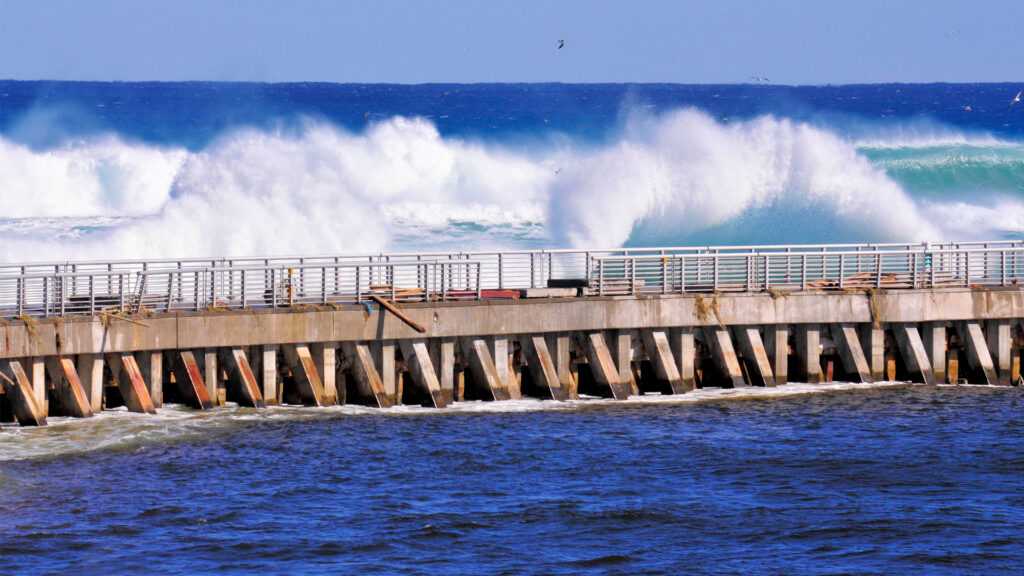
This piece was originally published at https://news.miami.edu/rosenstiel/stories/2026/04/a-critical-atlantic-ocean-current-shows-two-decade-slowdown-study-finds.html. Banner photo: Waves in the Atlantic Ocean (iStock image).
Sign up for The Invading Sea newsletter by visiting here. To support The Invading Sea, click here to make a donation. If you are interested in submitting an opinion piece to The Invading Sea, email Editor Nathan Crabbe.
