


This article originally appeared on Inside Climate News, a nonprofit, non-partisan news organization that covers climate, energy and the environment. Sign up for their newsletter here.
By Lisa Sorg, Inside Climate News
The destruction of wetlands in the United States has increased the amount of flood insurance claims by $10 billion over the past 40 years, a phenomenon expected to worsen in tandem with climate change, according to new research.
The peer-reviewed study, conducted by scientists at the University of North Carolina at Chapel Hill and the nonprofit Environmental Defense Fund, was published June 1 in the journal Nature Water.
The scientists used federal flood insurance claims data to calculate the dollar value of wetlands in reducing river flooding. They considered other factors as well, such as rainfall amounts and upstream changes in impervious surfaces, like parking lots and roofs.
In dollars, flood insurance claims have increased the most in the Houston metropolitan area, southeastern Louisiana and coastal Florida, according to the study.
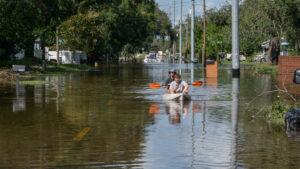
Quantifying the flood control benefits of wetlands is crucial in light of the U.S. Supreme Court’s rollbacks of wetlands protections under the Clean Water Act, said Adam Gold, senior manager for coasts and watersheds science at the Environmental Defense Fund.
“Wetlands provide benefits to people, and it’s important that we protect them,” Gold said.
Wetlands ease the severity of flooding. They store water, slow the velocity of its flow and reduce runoff. In 2023, the controversial U.S. Supreme Court decision, Sackett vs. EPA, narrowed the scope of the Clean Water Act and redefined wetlands to include only those with a continuous surface water connection with other water bodies.
The ruling stripped protections from millions of acres of wetlands that intermittently flood or whose hydrological connection with other water bodies is below ground. The value of flood-mitigation benefits from unprotected wetlands is an estimated $177 billion, according to the study.
North Carolina’s share of mitigation benefits from those unprotected wetlands is $4.6 billion. At least 52,000 acres of wetlands in the state have vanished from 1985 to 2023, according to the study.
Yet the dollar figures are likely an underestimate because the study focused on flooding along rivers and streams, and did not account for coastal and tidal inundations. Nor did researchers capture the value of losses not covered by the National Flood Insurance Program. Only a third of expected annual losses from flooding are insured by the NFIP, so the economic benefit of wetlands in preventing flooding is likely much higher.
“What really stood out to me was the value of existing wetlands for flood risk reduction that may no longer have protections either at the state or federal levels,” Gold said. “That shows the recent rollbacks and federal wetlands protections under the Clean Water Act and at the state level have really potentially large impacts on downstream communities.”

Wetland loss and subsequent flooding disproportionately affects communities of color and low-income neighborhoods, the researchers found. These residents often live in low-lying areas that are prone to repetitive flooding — a legacy of racist planning and zoning decisions — and are often too poor to afford flood insurance.
Market prices generally don’t reflect the economic losses of wetlands that are converted to other land uses, such as housing, data centers and strip malls, the study says. The costs, though, are incurred by the public rather than the property owner.
“While we know that wetland losses are occurring and have been increasing in recent years, it can be difficult to pinpoint the effects on the ground,” said Portia Osborne, executive director of the National Association of Wetland Managers, who was not involved in the study. “To put a dollar amount on that benefit is especially important as those headwater wetlands are the ones most likely to have lost protection post-Sackett.”
The Carolina Wetlands Association, a nonprofit based in Cary, N.C., has begun monitoring the Carolina Bays, a type of oval-shaped wetland depression found in coastal areas and which are largely unprotected.
Wetlands can be protected and restored through regulations and voluntary programs, such as conservation easements. The Carolina Wetlands Association will soon restore wetlands along Stony Run, a stream near Dunn, in Harnett County.
During Hurricane Matthew in 2016, a dam on Stony Run breached and killed someone. Nearby wetlands “are extremely disturbed,” said Rick Savage, executive director of the Carolina Wetlands Association. “We’re trying to put them back into better shape so if flooding like that happens again the wetlands can take care of it.”
Gold said he hopes federal, state and local policymakers can use the study to consider the economics of wetlands loss.
“Wetlands are really important ecosystems, not just because they have inherent value, but also because they provide important benefits to people,” he said. “There’s a lot of great new science coming out to quantify benefits of these natural ecosystems, and I think once we have a really, really full accounting of all their benefits … it’s going to make so much sense to protect them rather than allow further degradation.”
Banner photo: The Florida Fish and Wildlife Conservation Commission responds to the flooding of the St. Johns River following Hurricane Irma in 2017 (FWC photo by Chad Weber, CC BY-ND 2.0, via flickr).
Sign up for The Invading Sea newsletter by visiting here. If you are interested in submitting an opinion piece to The Invading Sea, email Editor Nathan Crabbe.
